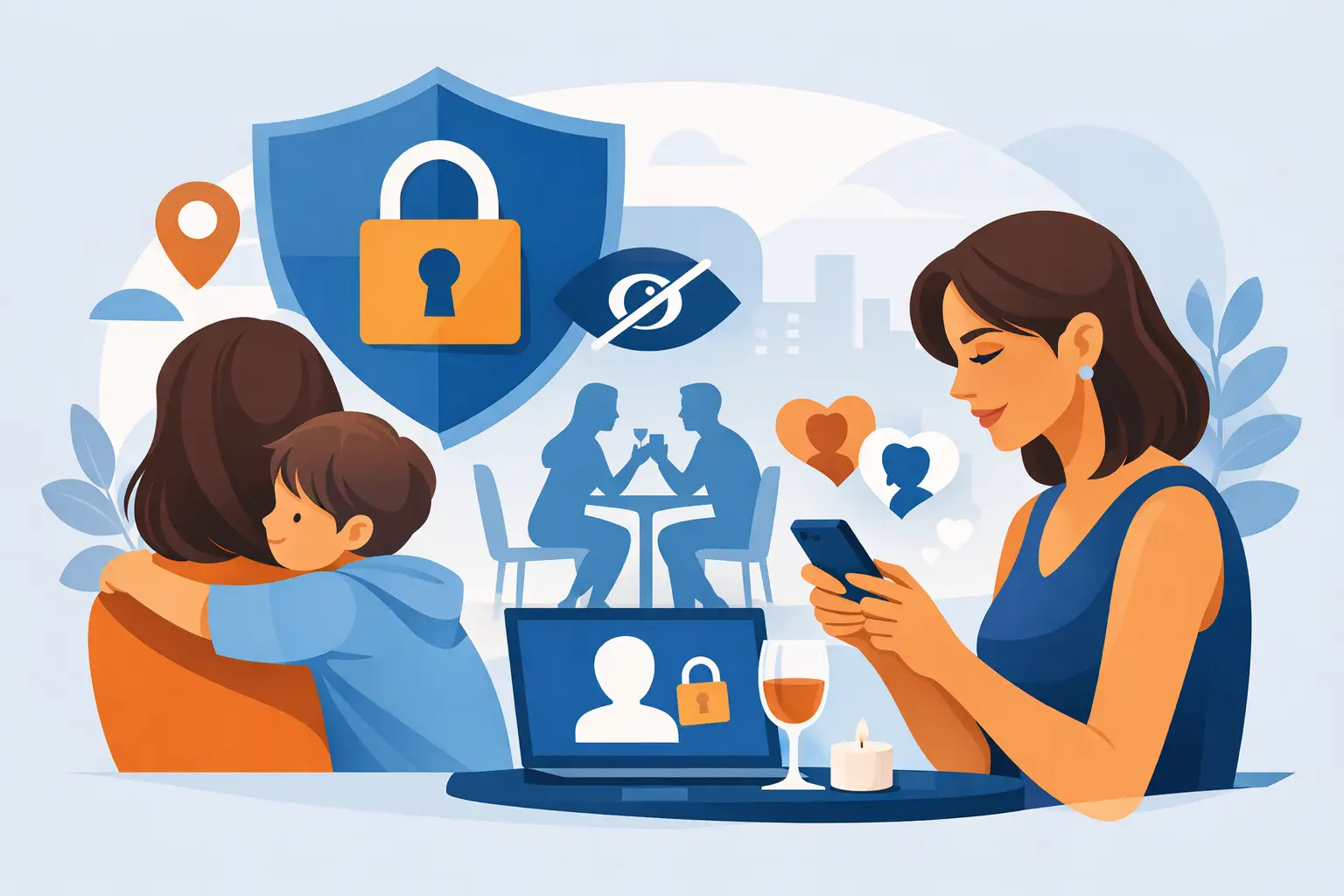
A dating profile can be the start of something exciting, but as a single parent, it also represents your home life, your routines, and the people who rely on you. Knowing how to protect dating privacy lets you show up honestly without handing a new match a detailed map of your family’s world. You do not have to be secretive to be safe. You just need to decide what someone has earned the right to know.
How to protect dating privacy from your first profile
Your profile should show your personality, not your personal records. Share the parts of your life that help the right person recognize a connection: what makes you laugh, how you spend a rare free evening, what you value in a relationship, and the kind of parent and partner you hope to be.
Keep identifying details out of the public version of your story. Use your first name or a nickname you are comfortable with, rather than your full name. Avoid listing your employer, your child’s school, your exact neighborhood, or the places you visit at the same time every week. A profile that says you enjoy early Saturday farmers markets is warm and real. A profile that names the market, the time, and the town gives away more than it needs to.
Photos deserve the same thought. Choose recent pictures that make you feel like yourself, but look past the main subject before posting. A visible house number, workplace badge, school uniform, team jersey, car license plate, or familiar neighborhood landmark can reveal more than you intended. If you share a photo with your children, consider whether you are comfortable with it being seen by people you have not met. Many single parents choose photos without their kids, especially early on. That is a boundary, not a lack of pride.
Keep your children’s identities separate
Being a parent is a meaningful part of dating as a single parent. You can say you have children, share their general age range if it feels relevant, and talk about the values parenting has taught you. You do not need to share their names, photos, school activities, custody schedule, or the other parent’s details.
A thoughtful match will understand that this information comes later, if and when a relationship becomes established. Someone who acts offended by this boundary is telling you something useful about their approach to trust.
Share gradually, not all at once
Privacy is not only about what you leave off a profile. It is also about pacing. The first few conversations are for learning whether there is mutual interest, not for exchanging your complete life history.
It can feel natural to open up quickly when someone seems understanding, especially if they also have kids and know the demands of parenting. Shared experience can create comfort fast. Still, let consistency build trust. A person can understand the challenge of school drop-offs and late-night laundry without knowing where your child goes to school or which weekends you are home alone.
Start with broad details, then become more specific as a connection develops. For example, you can say that your schedule depends on parenting responsibilities instead of sending a full custody calendar. You can explain that you work in health care, education, or a local business without naming your workplace right away. The right match will respect the difference.
Move communication at a pace that feels right
Messaging within a dating community gives you room to get to know someone before sharing a personal phone number, email address, or social media account. Use that space. Ask questions, notice whether their answers match over time, and pay attention to whether they respect a simple no.
Video chat can be a helpful next step before an in-person date. It adds a layer of real interaction and can help you confirm that the person matches their profile. Keep the call in a neutral area of your home, with family photos, mail, and children’s belongings out of view. You are there to have a conversation, not offer a tour of your private life.
When you do decide to exchange phone numbers, consider using a separate number through a reputable calling service. This can make it easier to keep dating conversations separate until trust is stronger. It may not be necessary for everyone, but it is a practical option if privacy is a high priority or you have a public-facing job.
Protect your location and digital footprint
Dating apps and social platforms can reveal patterns even when you never state your address. Be thoughtful about location features, check-ins, and photos posted in real time. It is usually safer to share an activity after you have left rather than while you are still there.
Before connecting a dating match to your personal social media, take a few minutes to review what is publicly visible. Old posts may include your last name, workplace, family members, hometown, children’s birthdays, or regular locations. You do not have to erase your life online. Adjusting privacy settings and removing public details is often enough.
Pay special attention to these common overshares:
- A photo of your child’s school event with the school name visible
- A screenshot that shows an email address, phone number, or calendar notification
- A post describing when your children are with the other parent
- A map, gym check-in, or neighborhood tag that reveals where you spend time
Your dating profile and your parent life can coexist without being fully connected. That separation gives you more control over when a new person enters the wider parts of your world.
Recognize pressure disguised as interest
A good connection should feel curious, not intrusive. Someone may ask personal questions because they are trying to know you better, but their response to your boundary matters more than the question itself.
Be cautious if a match pushes for your number immediately, asks where you live before planning a date, wants to move the conversation to another app right away, or keeps asking about your children after you have changed the subject. The same goes for someone who guilt-trips you with comments such as, “If you trusted me, you would tell me,” or “Why are you being so guarded?”
Trust is built through respect, reliability, and time. It is not proven by giving a stranger access to your private information. You can be direct without being harsh: “I like getting to know you, but I keep family details private until I know someone better.” A compatible person will hear that as a sign of good judgment.
Be alert for financial requests too. A person who creates a quick emotional bond, shares a dramatic crisis, and asks for money, gift cards, account help, or private photos is not building a healthy relationship. Stop engaging, save any relevant messages, and report the account through the platform.
Plan first dates with privacy in mind
Meeting in person is a meaningful step, and it should happen on terms that help you feel comfortable. Choose a public place you can reach on your own. A coffee shop, casual restaurant, museum, or daytime community event gives you an easy setting to talk without revealing your home address.
Drive yourself or arrange your own transportation for the first few dates. Tell a trusted friend where you are going, who you are meeting, and when you expect to check in. You can share the match’s profile and a screenshot of your plans if that makes you feel more secure. This is not being dramatic. It is a normal dating practice, especially when your choices affect your family.
There is no deadline for inviting someone into your home or introducing them to your children. Some relationships become serious quickly, while others need more time to prove they are stable. Let your actual level of trust, not loneliness or pressure, guide those decisions.
Build connection without giving up control
A community designed for single parents can make dating feel less like explaining yourself from scratch. On Single and Parent, you can meet people who already understand that a canceled plan may be about a sick child, a school event, or a schedule change. That shared reality can make conversations more meaningful, but it does not remove the need for healthy boundaries.
You can be open about wanting companionship, a relationship, or a blended-family future while still keeping your family’s identifying details private. In fact, that balance often helps you date with more confidence. You are choosing to share your life intentionally, rather than feeling pressured to make yourself fully available from the start.
The person who is right for you will not need immediate access to every part of your life to see your value. They will appreciate that you protect what matters, communicate clearly, and make room for connection when it feels safe and genuine.
2 thoughts on “How to Protect Dating Privacy as a Single Parent”